
The Dimraeth skill tree
Every race and class pairing has its own Dimraeth skill tree, laid out like a compass. The east and west wings belong to your class, the north and south wings to your race, and the corners between them hold skills only that exact pairing gets. Each level gives skill points (two, players report), and unlike attributes, skill points can be reset for a little gold.
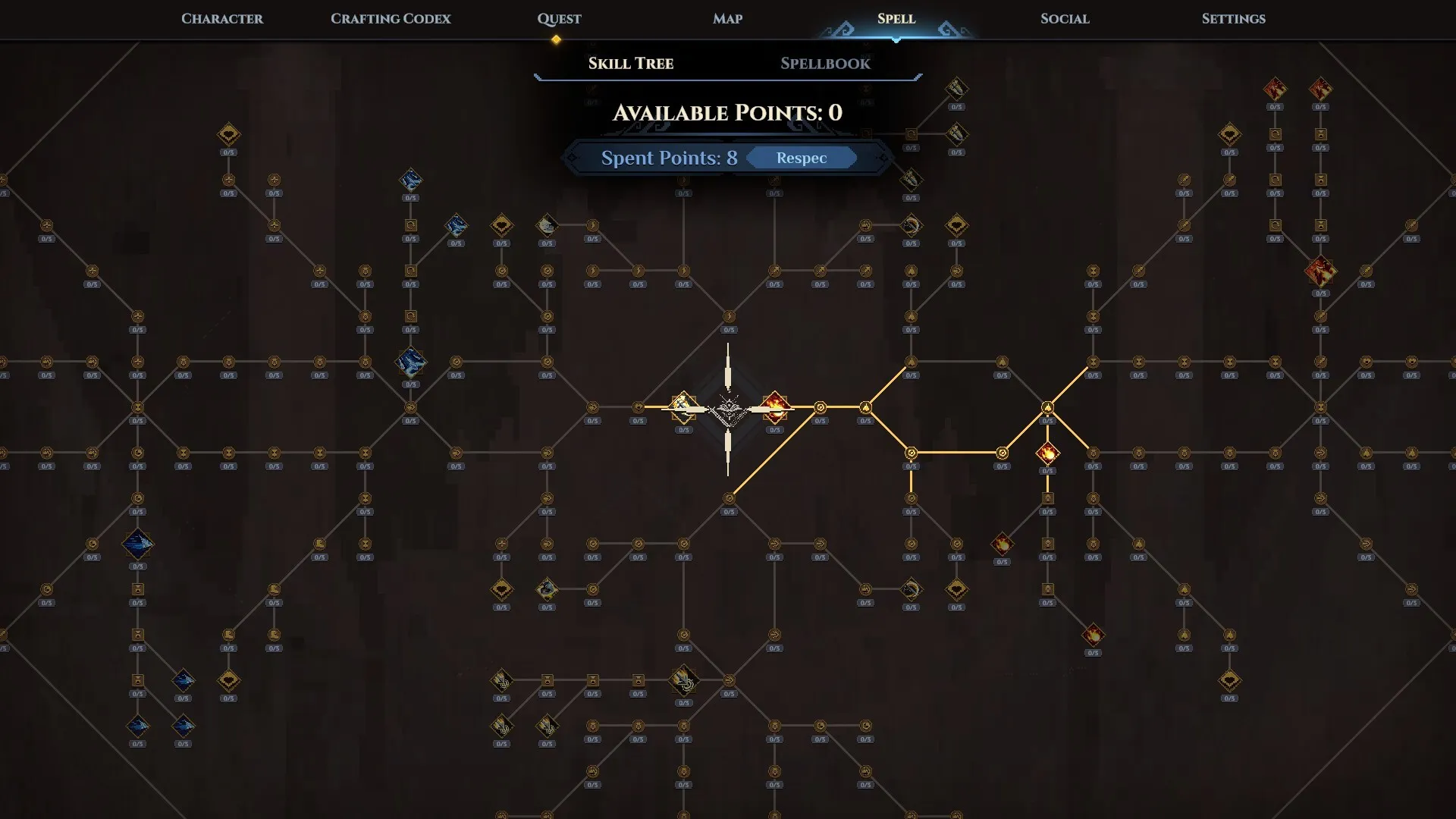
Read the tree like a compass
Class skills take east and west; race skills take north and south. What sits inside each wing depends on the character. Two examples:
| Wing | Belongs to | Human Brawler | Elf character |
|---|---|---|---|
| North | Race | Sword abilities | Striking and pierce damage |
| East | Class | Crowd control: blunt damage and stuns | Stealth, shadow and bleed damage |
| South | Race | Crossbow, ranged skills | Ether damage, temporal effects, melee hybrid |
| West | Class | Damage skills and buffs, such as rage | Poison |
| Corners | This race with this class | Hybrid nodes: skills no other pairing has | |
North tends to hold your race’s weapon skills and melee, south its ranged skills (the bow, or the Minotaur’s rock smash). That is the pattern players see, not a guaranteed rule. Which weapon each race carries is on Dimraeth races.
The corners are what makes your archetype yours
Mudtek puts it this way: “Combine any of eight races with any of six classes to create 48 distinct Archetypes. Each pairing has its own skill tree and playstyle.” (eight and six are the full-release plan; Early Access has three of each). Revvy expects most nodes to look alike from tree to tree, with small differences such as strike damage instead of pierce between races.
The corners are where trees really part. The hybrid nodes at the north-west, north-east, south-west and south-east are unique to your race and class combination and add functionality to certain skills and builds. One player observes that the race half of the tree stays the same whatever your class. All nine pairings and their archetype names are on Dimraeth archetypes.
Inside a wing: small, major and medium nodes
A wing has three kinds of node. Look at the major nodes before you commit points to a path.
After every major node comes a branch of modifiers that further empower the skills connected to it. The tree does not always explain what a node interacts with; the forum moderator says the team is working on a fix.
Use the search box. Searching the tree for “elf” turns up powerful modifiers for the Elf spell. Nodes that mention Perfect Vanish refer to a perfectly timed Elf defensive: instead of the shield, your character teleports behind the enemy. How the defensive works is on Dimraeth combat.
How many points you get
- Per level: two, in player guides. Levels come from spending XP on attributes, explained on Dimraeth leveling.
- From quests: some quests give skill points.
- At the cap: the Early Access cap is level 25; players report about 60 points in total.
- From mini-bosses: players report +1 for the first defeat of each.
The total at level 25, as players count it
A developer reportedly put the Early Access total at about 60 points for the level 25 cap. Players at the cap report 56, 59 and 60. If you are short, the usual gap is mini-bosses: the first defeat of each is reported to give +1 skill point, and some players think certain achievements add a few more. One player at 59 could not find the last mini-boss; see Woldroot, the tenth boss players report missing. The mini-boss achievement is on Dimraeth bosses.
Do not place more points than you have: a player who managed it ended up with a character that crashed on load. The report and the developer’s reply are on Dimraeth bugs and fixes.
Spells: the tree is only one way to get them
A node that raises “physical power” does nothing for a spell that deals fire damage, so read the damage type on the node before you spend: Dimraeth damage types and scaling sorts which is which.
You fight with five spells at a time, and the tree is only one place they come from.
“Equip five spells at a time and build tactical rotations and combinations around your loadout.”
Mudtek
“Your race and class offer their own spells, while crafted spellbooks grant access to universal magic, provided you meet each spell’s attribute requirements.”
Mudtek
- Find a glowing spell book in the world. It is a ruined book: what it teaches is the recipe for restoring it, not the spell.
- Craft the book at a trainer: Rahaner for melee skills, Tamson and Miral for magic spells. Captions also spell the melee trainer Raina or Rahanner.
- Use the crafted book from your inventory to learn the spell, if your attributes meet its requirements.
- Put it on one of your five spell slots.
Boss drops are used in specific skill recipes, so you can craft them all instead of being gated to one choice. Which bosses exist is on Dimraeth bosses. Nodes can also change a spell you already have: a Human can set Weapon Swap in the skill tree to only one type (Crossbow or Sword) or enhance its usage.
Resetting skill points
Use the Respec button on the tree screen. You get a couple of free points to move around at first; after that it costs some gold. Rahaner in the Guild also respecs skill tree points. Attribute points are another matter, and players report two different answers; both are on Dimraeth leveling and respec.
Anything from the demo is out of date
The skill tree was overhauled for Early Access, so node lists and point counts written about the demo or playtests do not describe this tree. The rest of what changed since the demo is on what is in Dimraeth Early Access, and finished point plans for this build are on Dimraeth builds.